

 : 产品列表(参数搜索)


- 型号 & 关键词搜索
- 交叉搜索
- 参数搜索
- 库存查询与购买
This webpage doesn't work with Internet Explorer. Please use the latest version of Google Chrome, Microsoft Edge, Mozilla Firefox or Safari.
请输入3个以上字符 Search for multiple part numbers fromhere.
The information presented in this cross reference is based on TOSHIBA's selection criteria and should be treated as a suggestion only. Please carefully review the latest versions of all relevant information on the TOSHIBA products, including without limitation data sheets and validate all operating parameters of the TOSHIBA products to ensure that the suggested TOSHIBA products are truly compatible with your design and application.Please note that this cross reference is based on TOSHIBA's estimate of compatibility with other manufacturers' products, based on other manufacturers' published data, at the time the data was collected.TOSHIBA is not responsible for any incorrect or incomplete information. Information is subject to change at any time without notice.
请输入3个以上字符
What is the difference between TVS diode and Zener diode for protection?
Both are diodes designed to protect circuits from electrostatic discharge (ESD) and overvoltage surges, but the types of surges they handle, and their applications differ.
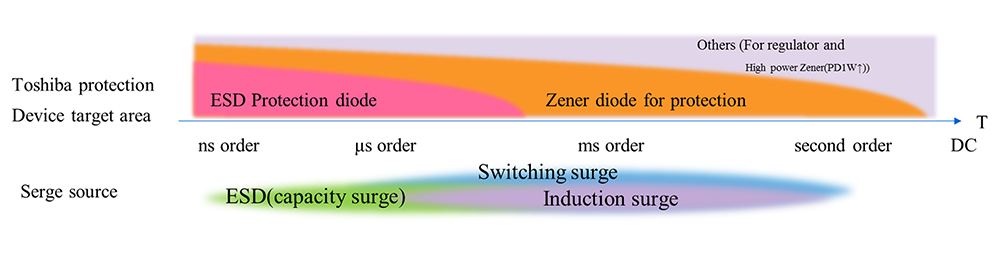
Our lineup of TVS (Transient Voltage Suppressor) diodes and protection Zener diodes are semiconductor devices that utilize the reverse characteristics of diodes and have the following features.
- TVS Diode
Primarily protects circuits from ESD, switching surges, and other transient overvoltage events. Under normal conditions, they remain in a non-conductive standby state. When an abnormal overvoltage surge occurs, they respond at nanosecond-level speed to clamp the voltage and protect the circuit. TVS diodes are mainly used for communication lines and power lines, but products with low terminal capacitance are also available, making them suitable for high-speed communication line protection.
- Protection Zener Diode
Similarly, these diodes protect circuits from transient overvoltage surges such as ESD and switching surges. However, they can also handle surges that are close to DC, which TVS diodes cannot effectively address. They are mainly used for protecting power line sections.
Such protection devices are widely used to safeguard communication lines and power lines in consumer, industrial, and automotive equipment.
The following summarizes the coverage areas of TVS diodes and protection Zener diodes for your reference.
| ESD protection (TVS) diode | Protection Zener diode | |
|---|---|---|
| Main applications | Protection against overvoltage surges of microsecond order or less*1 | Protection against overvoltage surges longer than microseconds (Can also be used for ESD protection *1) |
| Terminal-to-terminal capacitance*2 | 0.12pF to 600pF | 100pF to 600pF |
| Examples of usage locations | USB, HDMI connectors, power lines etc. | Power lines, power control lines |
| Remarks | Lineup mainly consists of products with low capacitance of 1pF or less. | If within allowable loss, protection is possible even from overvoltage pulses close to DC. |
*1 Applicable standards: IEC61000-4-2, IEC61000-4-5 (8/20μs conditions)
*2 For details, please refer to the individual data sheets
Related Links
There are related explanations in the following materials, so please refer to them.
FAQs
Application Notes
* Company names, product names, and service names used in this FAQ may be of their respective companies.